
What the warehouse can tell you about identity
Inspection answers one question well: is this the thing the order named. It is published as explicitly not answering several others, and the list of those is the useful part.
Type what you are after in English. What comes back is product cards, each pointing at one listing.
The scope
Checked, and explicitly not checked
Reading the QC photographs is the one job this page is about. Basic inspection is published as appearance checks, quantity checks, visible defect checks and standard QC photos: style, colour, quantity, size, model, visible damage, stains and obvious appearance issues.
The exclusions are published with the same clarity, and they are the half you need.
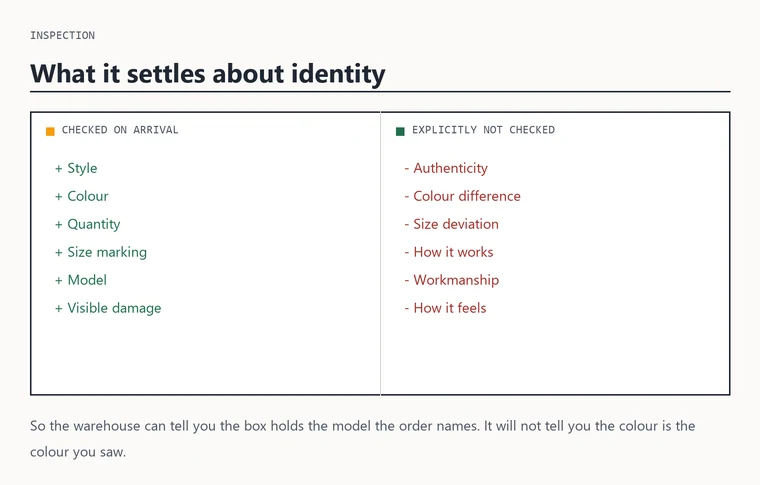
Authentication, professional functionality tests, subtle workmanship differences, subjective feel, color difference, size deviation, or internal quality problems are generally not included in the basic inspection scope.
the operator's FAQ, captured 2026-10-10
Read those two lists against each other and the boundary is sharp. The warehouse confirms that the box holds the model the order names. It does not confirm that the colour is the colour you saw, that the size fits, or that the thing is what the title claims it is.
Questions people bring
Which ones a photograph can settle
Half of what people hope to read from a set of inspection photographs is in the bottom four rows.
| The question | Can the photographs answer it |
|---|---|
| Did the right model arrive | Yes. This is the main thing the check is for |
| Is the count right | Yes, and nothing else is as easy to prove |
| Is the colour the one on the listing | No. Colour difference is named as out of scope |
| Will it fit | Not from the standard set. Size deviation is named as out of scope; the measurement service exists for this |
| Is it authentic | No. Authentication is named as out of scope |
| Does it work | No. Functionality testing is named as out of scope, and for electronics this is the whole question |
Method
How to check QC photographs, in four passes
The first two passes find problems that are provable, and provable problems are the only ones a claim is likely to turn on.
Count before you look
Quantity first, because it is both common and instantly provable. Two of three shirts is a shortage, and a shortage raised on arrival is a different conversation from one raised after shipping.
Match the model against your own order
This is what the check is for, and it only works if your order said something specific. An order that said the near match passes inspection as the near match. Why that matters.
Buy the measurement if fit is the question
Size measurement, detailed photographs and video are offered as paid extras, and can be added after the standard photographs are up. That timing is useful: you can look first and decide whether it is worth it.
The standard pass is included. Anything beyond it is a service you ask for.Swipe the image to read it, or tap to open full size. Keep the set, whatever you decide
They are dated, they came from a third party, and they are the only contemporaneous record either side will have if something is argued about later.
A close-up answers a close-up question
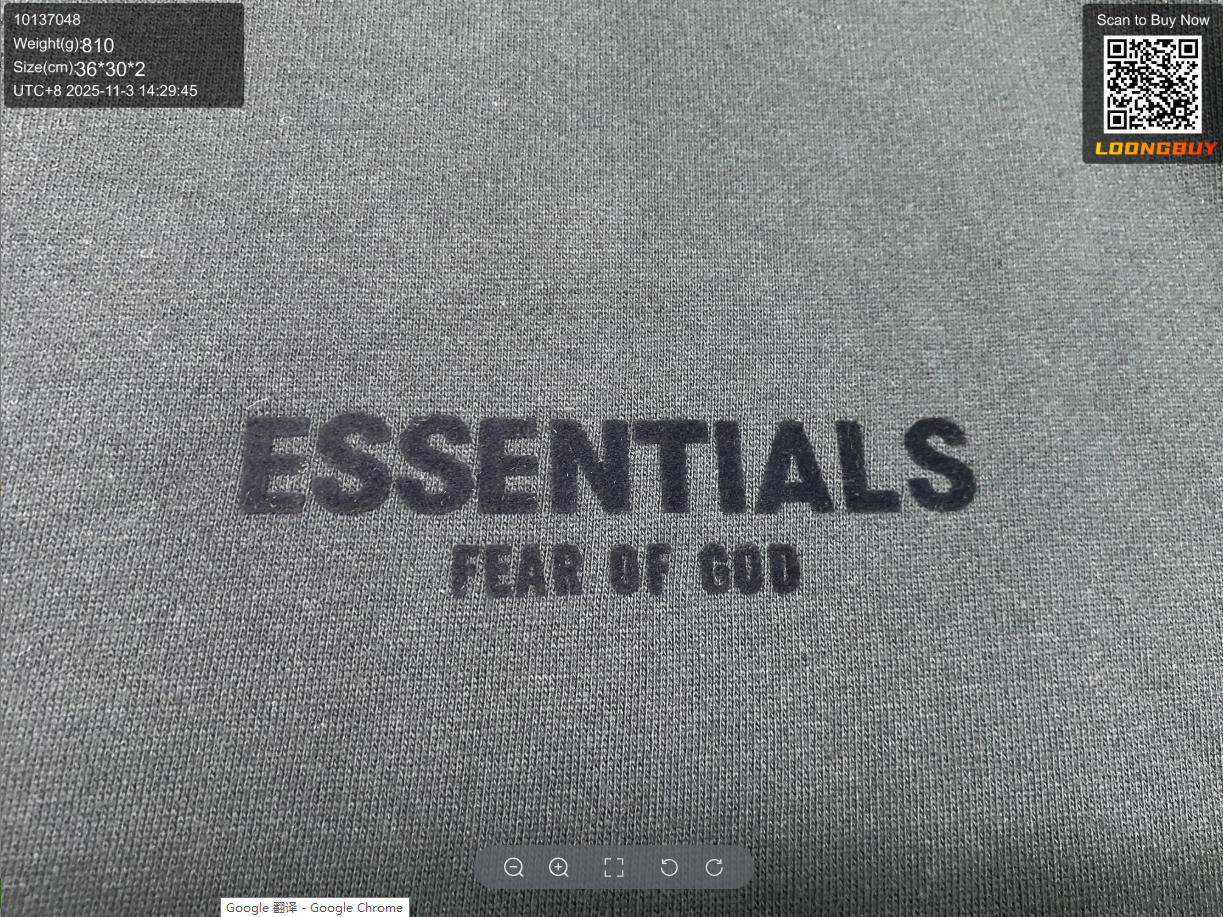
The archived example below makes the printed lettering and fabric surface visible. It helps you compare a visible detail with the selected listing. It does not measure the garment, reveal hidden stitching, authenticate the branding or establish how the print behaves after washing.
Read the whole-item views before the detail view so you know which piece the close-up belongs to. If fit is your concern, specify the measurement and units you need. If you ordered several sizes, identify the relevant order and size group rather than asking for an unidentified extra picture.
Keep the original photo set with the saved listing and request any missing evidence before deciding on shipping. The weight and dimensions printed in an old sample belong to that photographed item; they are not a standard weight for this category or a current freight input.
Questions
About the photographs themselves
Do I have to ask for the photographs?
No. Standard inspection photographs are described as part of the basic service, taken when goods are checked in.
Sealed items: will they open the box?
Not for sealed goods. The published rule is that sealed packaging and items with seal labels are inspected without being opened, with the appearance and the outer packaging checked instead. If the only way to know is to open it, the warehouse is not the one who will find out.
Electronics: is anything tested?
No. Authenticity, functionality and quality for electronics are named as outside the inspection scope. For that group the photographs confirm the model and nothing else.
The photographs look fine but the item is wrong. Any use?
Yes. It is dated, and it fixes what came out of the box. It will not prove an invisible fault, but it does rule out the claim that the damage happened later, which is the argument that usually follows.